Sunday, October 9, 2011
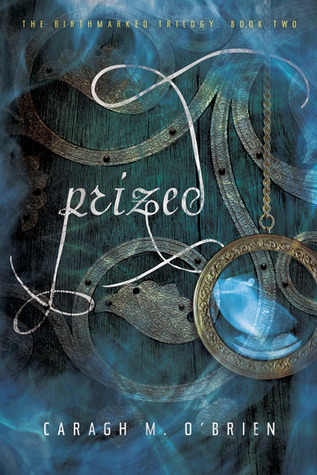
Prized by Caragh M. O'Brien
This story starts out where Birthmarked leaves off, after Gaia has escaped the wall of the Enclave with her baby sister Maya, and has set off to find her grandmother's settlement in the wasteland. When she finally comes across a matriarchal community called Sylum, where women are far more scarce than men.
Because the ruler of these people in Sylum has saved both her and her sister's life, she is indebted to them. They respect and honor her for being female, and value her skills as a midwife. In many ways they treat her well, and better than she had been treated both on the outside and inside of the walls of the Enclave. But, because of Gaia's unwillingness to respect and value all of the customs and laws of Sylum, she is also harshly punished at times. Gaia suffers from what I will call a strange version of Stockholm Syndrome where she has to fight her internal struggle to both value and help this new community to thrive, while also wanting to rebel against it's laws and government.
I'll blame it on her inner confusion, but I found that at at times she would make sacrifices for one cause or another (even when she was not sure if it was the right thing to do) that had potentially catastrophic consequences. Other times where it seemed obvious what she should do to help someone that needed her, she would do nothing and leave someone she was really indebted to, without her help. I really didn't agree with a lot of her decisions in this book. This is something that really bothered me when I was reading this book. But I understand that not every character in every story is going to do what I want them to do. While I'm talking about things that I personally don't like, I will also say that I get queasy with the talk of the pregnancy exams and uterus issues, and blood and things of the like. This was in the first book and is here again because of course Gaia is a midwife. I know it's necessary but it makes me queasy! There I've said it.
On to brighter things! Given the male-to-female ration here, Gaia has no shortage for love interests. And because the love triangle is a very common theme in many stories, Gaia is unique in having more than just two options to choose from!
I really enjoyed Birthmarked and I also really enjoyed the story told in Prized as well (aside from my already mentioned issues) I look forward to continuing this series and seeing where it goes. Because this story and even the culture and setting of Prized was so different from Birthmarked, I would really like to see the two 'worlds' of the two books collide and see how that plays out. I am hoping that is where book number three will be headed.
Tuesday, October 4, 2011
Forgotten by Cat Patrick
Each night when 16 year-old London Lane goes to sleep, her whole world disappears. In the morning, all that's left is a note telling her about a day she can't remember. The whole scenario doesn't exactly make high school or dating that hot guy whose name she can't seem to recall any easier. But when London starts experiencing disturbing visions she can't make sense of, she realizes it's time to learn a little more about the past she keeps forgetting-before it destroys her future.
Part psychological drama, part romance, and part mystery, this thought-provoking novel will inspire readers to consider the what-if's in their own lives and recognize the power they have to control their destinies.
My Review:
This was a really entertaining read for me. It was kind of fun to consider the concept of "remembering" only the future and having no memories of the past. It's tough to believe London and Luke's relationship would be able to progress as far as it did when her memory hit a reset button every morning at 4:33am. Her knowledge of him and their relationship was based only on her notes to herself from the days before and her attraction to him each time she saw him... but this is a work of fiction so I'm not complaining too much... I liked how in the end she was able to remember something very important which gave a purpose to the story. But even without the purpose, I liked the characters, and like I said, it was an entertaining story and a fun concept.
Saturday, October 1, 2011
Amy & Roger's Epic Detour by Morgan Matson
Sunday, September 25, 2011
3 Month YA Reading Challenge
Duration: September 1, 2011 - November 30, 2011.
You have 3 months to read 10 YA books that satisfy following requirements:
All finished as of 10/18/2011
I've heard that people either LOVE or HATE this book. I guess I love it, because I definitely didn't hate it. It made me laugh. I don't know that I was able to fully appreciate it for it's literary brilliance or whatever. I don't love all of the content either. But for some reason the Holden's voice of narration was just funny and entertaining to me.
What can I say? I love everything Rachel Vincent writes! This book did not disappoint! I was definitely surprised by where she took the story... it was a direction I would never have predicted. I am excited to see where it goes from here. I'm a little sad that each book takes me 2 days to read and then I'm left waiting another 11 months or so for the next one, but I am definitely eager to continue in the torture.

Ok so I'm not only reading this for the cover, this is the 3rd book in a series and I've read the first two before this. But I do think the cover is great, and also I might have only started this series based on the cover of the first book, so I think it still counts. ** Full review posted 10/16/11**
Sunday, September 18, 2011
Series Review: The Confessions of Georgia Nicholson
This series was so fun and entertaining to read. The books aren't very long, so it didn't take too long to finish all 10 of them. Each book had me laughing out loud even when I was trying to read quietly. Some of the imagery that Louise Rennison created with in her stories was so hilarious and absurd that I can't be blamed. I loved Georgia and her insane sense of humor and drama.... some of my favorite highlights to follow...
Sunday, April 10, 2011
The Book Thief by Markus Zusak
This is my review from when I read this book for my book club so it is a bit different from my other reviews and very long:This was such a good book and I really enjoyed reading it! It has some different perspectives and styles from other stories that take place in Nazi Germany. I feel like writing this review with the use of many references and quotes I read the following online and thought I would share.
First, about how/why the author chose his perspective:
“Zusak wrote The Book Thief in response to a series of stories his mother told him of growing up in Munich during the Second World War, including that of a teenage boy giving a piece of bread to a marching Jew. In an interview with the Sydney Morning Herald he said: ‘We have these images of the straight-marching lines of boys and the ‘Heil Hitlers’ and this idea that everyone in Germany was in it together. But there still were rebellious children and people who didn’t follow the rules and people who hid Jews and other people in their houses. So there’s another side to Nazi Germany.’”
Next, about chosing death as a narrator he said:
“The identity of Death was there from the beginning, and there were two turning points when it came to tone and style. The first was nine months into writing, when I went back to the beginning and wrote the first aside: ‘Here is a small fact: You are going to die.’ That gave me the tone I wanted, and by default, I had the unusual trait of cordoning off small sections for Death to whisper in the reader’s ear.
The second turning point was when I realised that Death should be afraid of humans, because he is on hand to see all of the incomprehensible things we do. It gave me the idea that he tells this story to prove to himself that humans are actually worth it. Also, the irony that Death is afraid of humans really appealed to me.”
And last about the writing style (that I called quirky in my earlier post) he explains:
“I wanted Death to view the world slightly differently to the way we do, and I liked the thought that this book would be unlike any other. I didn’t go out of my way to make it different, but again, I just recognized the ideas, asked if they fit the story, and left them in.”
Of course the subject matter of the Holocaust is very very sad. But I liked how even though Liesel was not immune to many of the horrible effects of war, her life was not completely ruined by it either. I felt sooo sad for her when she lost everyone she loved and had so little to hold on to in the end, but at least she was taken in by the Mayor’s wife, who shared her books with her and she lived a long life afterward.
One thing I liked was how the narrator “spoiled” the ending. I think I might have cried a little when death told us that Rudy was going to die young, before the book was even halfway through (on page 242) but I think it would have been a lot worse for me when Rudy died if I hadn’t already known it was coming.
Overall this book was great, and super sad. But, I didn’t feel depressed at having read it, so that’s a plus. There was enough sunlight mixed in with all the darkness that it don’t have the urge to erase the whole thing from my memory (like with some other Holocaust stories) Even though almost all of the characters had a lot of fear and sadness in their lives, and lived during a very difficult time, we got to see humor and happiness in their stories too.
I think after I read “The Standover Man” I knew for sure that I loved this book. I also really liked “The Word Shaker” They were both cute and touching.
I liked the character development of all of the main characters, and how their relationship with Liesel were expressed. I especially loved:
Rudy…
“A snowball in the face is surely the perfect beginning to a lasting friendship.”
“The only thing worse than a boy who hates you: a boy that loves you.”
“He was the crazy one who had painted himself black and defeated the world.”
“How about a kiss, Saumensch?”
“he was a giver of bread and teddy bears. He was a triple Hitler Youth athletics champion. He was her best friend. And he was a month from his death.”
Max…
“It was a Monday and they walked on a tightrope to the sun.”
“The best standover man I’ve ever known is not a man at all.”
“Often I wish this would all be over, Liesel, but then somehow you do something like walk down the basement steps with a snowman in your hands.”
Papa…
“Possibly the only good to come out of these nightmares was that it brought Hans Hubermann, her new papa, into the room, to soothe her, to love her.”
“Goodbye, Papa, you saved me. You taught me to read. No one can play like you. I’ll never drink champagne. No one can play like you.”
even Mama….
“Make no mistake, the woman had a heart. She had a bigger one than people would think. There was a lot in it, stored up, high in miles of hidden shelving. Remember that she was the woman with the instrument strapped to her body in the long, moon-slit night. She was a Jew feeder without a question in the world on a man’s first night in Molching. And she was an arm reacher, deep into a mattress, to deliver a sketchbook to a teenage girl.”
and even Death….
“I wanted to tell the book thief many things, about beauty and brutality. But what could I tell her about those things that she didn’t already know? I wanted to explain that I am constantly overestimating and underestimating the human race-that rarely do I ever simply estimate it. I wanted to ask her how the same thing could be so ugly and so glorious, and its words and stories so damning and brilliant.”
This concludes my book report… The End.